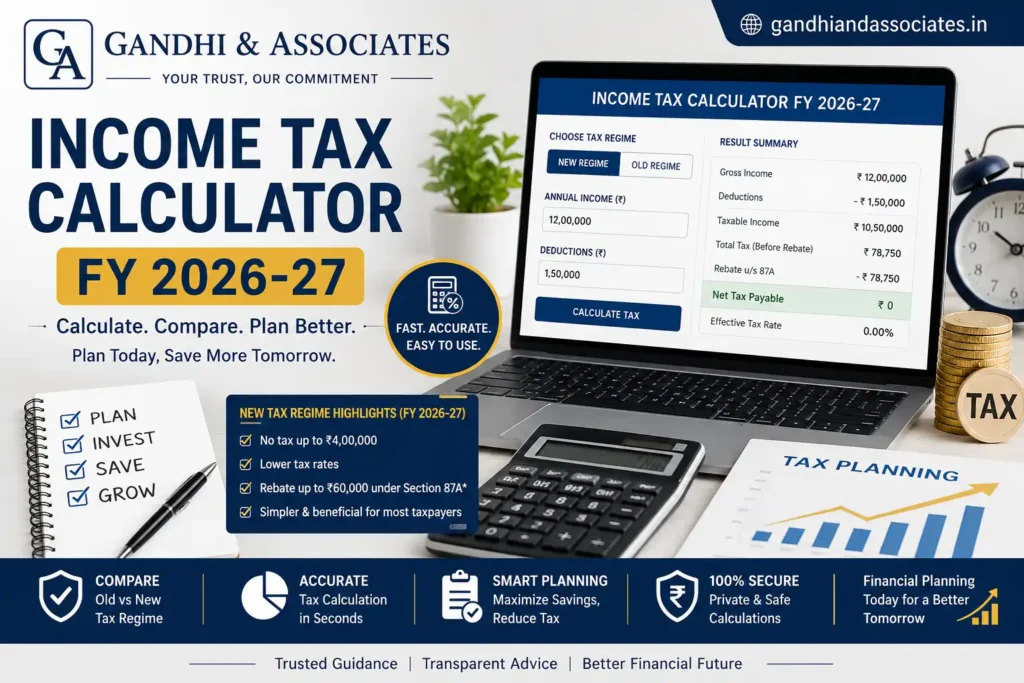
Income tax planning has become an essential part of personal financial management in India. Whether you are a salaried employee, self-employed professional, freelancer, business owner, or retiree, understanding your tax liability before the financial year ends can help you make better financial decisions.
This is where an Income Tax Calculator FY 2026-27 becomes extremely useful.
Instead of manually calculating tax using different slabs, deductions, cess, and rebate provisions, an income tax calculator helps estimate your tax liability within seconds. It allows taxpayers to compare old and new tax regimes, evaluate tax-saving opportunities, and plan investments more effectively.
Since 2023, while working on financial content, documentation processes, and online advisory resources, I have noticed that many taxpayers wait until the last few months of the financial year to understand their tax obligations. Unfortunately, by that stage, many tax-saving opportunities may already have been missed.
Using an income tax calculator early in the financial year provides greater clarity and helps individuals make informed financial choices.
This comprehensive guide explains how income tax calculators work, current tax slabs, differences between old and new tax regimes, tax planning strategies, and common mistakes taxpayers should avoid.
What Is an Income Tax Calculator?
An Income Tax Calculator is an online tool that estimates the amount of income tax payable based on your income, deductions, exemptions, age category, and selected tax regime.
The calculator simplifies tax computation by automatically applying relevant tax slabs and rules.
Most modern tax calculators can:
- Estimate annual tax liability
- Compare old and new tax regimes
- Calculate tax payable after deductions
- Show effective tax rates
- Help identify tax-saving opportunities
- Estimate monthly tax impact
Instead of performing complex calculations manually, users simply enter financial details and receive instant results.
Why Tax Planning Matters in FY 2026-27
Many taxpayers think about taxes only during return filing season.
However, tax planning should ideally begin at the start of the financial year.
Effective tax planning helps:
- Reduce tax liability legally
- Improve cash flow management
- Increase savings
- Support investment planning
- Avoid last-minute decisions
- Improve financial discipline
An income tax calculator acts as a financial planning tool rather than merely a tax estimation tool.
Income Tax Slabs FY 2026-27 (New Tax Regime)
The new tax regime continues to be the default tax regime for most taxpayers unless they opt for the old regime under applicable provisions.
The widely referenced slab structure includes:
| Annual Income | Tax Rate |
|---|---|
| Up to ₹4,00,000 | Nil |
| ₹4,00,001 – ₹8,00,000 | 5% |
| ₹8,00,001 – ₹12,00,000 | 10% |
| ₹12,00,001 – ₹16,00,000 | 15% |
| ₹16,00,001 – ₹20,00,000 | 20% |
| ₹20,00,001 – ₹24,00,000 | 25% |
| Above ₹24,00,000 | 30% |
In addition, eligible taxpayers may benefit from rebate provisions under Section 87A subject to prevailing rules and conditions.
Understanding these slabs is essential because even small differences in taxable income can affect overall tax liability.
Read This: GST Registration Process India Online
Old Tax Regime vs New Tax Regime
One of the most common questions taxpayers ask is:
Which tax regime should I choose?
The answer depends on your financial profile.
Old Tax Regime
Advantages:
- Allows various deductions and exemptions
- Suitable for taxpayers with significant investments
- Can benefit individuals claiming housing loan deductions and insurance-related benefits
Common deductions include:
- Section 80C
- Section 80D
- Home loan benefits
- Certain eligible exemptions
New Tax Regime
Advantages:
- Lower slab rates
- Simplified tax structure
- Reduced paperwork
- No need for extensive tax-saving investments
Many taxpayers with limited deductions find the new regime more beneficial.
Using an Income Tax Calculator FY 2026-27 helps compare both options and identify the most suitable regime.
How an Income Tax Calculator Works
Although calculators may vary slightly, most follow a straightforward process.
Step 1: Enter Annual Income
Include:
- Salary income
- Business income
- Professional income
- Rental income
- Other taxable income
Step 2: Select Tax Regime
Choose:
- Old Tax Regime
- New Tax Regime
Step 3: Enter Deductions (If Applicable)
Examples include:
- Section 80C investments
- Health insurance premiums
- Home loan deductions
- Other eligible tax-saving investments
Step 4: Review Results
The calculator typically displays:
- Taxable income
- Total tax payable
- Rebate adjustments
- Health and Education Cess
- Net tax liability
The process takes less than a minute but can provide valuable financial insights.
Example of Income Tax Calculation
Suppose an individual earns:
- Annual Salary: ₹12,50,000
- No major deductions
- Chooses New Tax Regime
The income tax calculator automatically applies the relevant slab rates and computes estimated tax liability according to prevailing tax provisions.
Without a calculator, this process can become confusing and time-consuming.
My Experience Using Tax Calculators Since 2023
Since 2023, I have worked extensively with financial content, loan-related resources, insurance guides, and tax-planning discussions.
One pattern became very clear.
Most taxpayers are not confused by tax laws alone.
They are overwhelmed by the volume of information available online.
Many people read multiple articles, compare conflicting advice, and still remain uncertain about their actual tax liability.
This is where a reliable income tax calculator becomes valuable.
Instead of relying solely on assumptions, users can instantly see how income, deductions, and regime selection affect tax obligations.
I have personally seen taxpayers discover that:
- The new regime offered lower tax liability.
- Existing deductions justified staying in the old regime.
- Additional investments could improve tax efficiency.
- Certain assumptions about tax savings were incorrect.
The calculator often removes uncertainty and helps people make decisions based on actual numbers rather than guesswork.
Common Mistakes Taxpayers Make
Waiting Until March
Many individuals postpone tax planning until the final weeks of the financial year.
This limits available options.
Choosing a Regime Without Comparison
Selecting a tax regime without comparing both alternatives can lead to higher tax liability.
Ignoring Deductions
Many taxpayers fail to claim eligible deductions simply because they are unaware of them.
Not Reviewing Salary Structure
Salary restructuring may sometimes improve tax efficiency.
Relying on Outdated Information
Tax rules change frequently.
Using updated calculators and reliable information sources is important.
Benefits of Using an Online Income Tax Calculator
Saves Time
Manual tax calculations can be complicated.
An online calculator delivers results instantly.
Improves Financial Planning
Tax estimates help individuals manage savings and investments more effectively.
Reduces Errors
Automated calculations minimize human mistakes.
Helps Compare Tax Regimes
Side-by-side comparisons make decision-making easier.
Supports Tax Saving
Users can evaluate the impact of deductions and investments before making financial commitments.
Tax Saving Strategies for FY 2026-27
While an Income Tax Calculator helps estimate tax liability, the real value comes from using that information to make smarter financial decisions.
Many taxpayers focus only on filing returns, but experienced financial planners understand that tax planning should happen throughout the year.
Invest Early Instead of Waiting Until Year-End
One of the biggest mistakes taxpayers make is waiting until January, February, or March to start tax planning.
Investing gradually throughout the year offers several advantages:
- Better cash flow management
- Reduced financial pressure
- Improved investment discipline
- More time to evaluate options
Review Your Tax Regime Every Year
The best tax regime for one year may not be the best option next year.
Factors that influence regime selection include:
- Salary increases
- New investments
- Home loan status
- Insurance purchases
- Family responsibilities
Using an updated Income Tax Calculator FY 2026-27 helps determine which regime works best for your current situation.
Read This: Income Tax Filing Online India: A Step-by-Step Guide for 2026
Important Tax Deductions Under the Old Tax Regime
For taxpayers considering the old regime, understanding available deductions remains important.
Section 80C
One of the most widely used deductions.
Eligible investments may include:
- Public Provident Fund (PPF)
- Employee Provident Fund (EPF)
- ELSS Mutual Funds
- Tax Saving Fixed Deposits
- Life Insurance Premiums
Section 80D
Provides deductions for eligible health insurance premiums.
Can benefit:
- Self
- Spouse
- Children
- Parents
Home Loan Benefits
Homeowners may claim eligible deductions under applicable provisions.
These deductions can significantly influence regime selection.
National Pension System (NPS)
Additional deductions may be available under relevant provisions.
For many taxpayers, these benefits can reduce taxable income substantially.
Income Tax Calculator for Salaried Employees
Salaried employees are among the largest users of tax calculators.
A calculator helps employees:
- Estimate annual tax liability
- Compare tax regimes
- Understand take-home salary impact
- Evaluate tax-saving investments
Important salary components often include:
- Basic salary
- HRA
- Bonuses
- Allowances
- Other taxable benefits
By entering these details, employees gain a clearer picture of their financial obligations.
Income Tax Calculator for Self-Employed Professionals
Self-employed individuals often face more complex tax situations.
Examples include:
- Consultants
- Freelancers
- Doctors
- Architects
- Lawyers
- Business owners
Their income may fluctuate throughout the year, making tax estimation more challenging.
An income tax calculator can help:
- Forecast tax liability
- Plan advance tax payments
- Improve cash flow management
- Avoid unexpected tax burdens
Income Tax Calculator for Business Owners
Business owners frequently deal with:
- Variable income
- Business expenses
- Investments
- Expansion plans
Tax planning becomes especially important in these situations.
A calculator allows business owners to estimate liabilities and make informed financial decisions before the financial year ends.
Who Should Use an Income Tax Calculator?
The short answer:
Almost everyone with taxable income.
Salaried Employees
To estimate annual taxes and compare regimes.
Freelancers
To manage irregular income streams.
Business Owners
To improve financial planning.
Retirees
To understand tax obligations on eligible income sources.
Investors
To evaluate the tax impact of financial decisions.
Why Online Income Tax Calculators Are Becoming More Popular
India’s financial landscape is becoming increasingly digital.
Today, taxpayers prefer tools that provide:
- Instant results
- User-friendly interfaces
- Real-time calculations
- Regime comparisons
- Better financial insights
As tax rules evolve, calculators help simplify decision-making.
Instead of spending hours reviewing complex provisions, users can obtain estimates in seconds.
How Gandhi & Associates Views Tax Planning
At Gandhi & Associates, we often emphasize that tax planning should not be viewed solely as a compliance exercise.
Effective tax planning contributes to:
- Better financial discipline
- Improved cash flow
- Long-term wealth creation
- More informed investment decisions
The goal is not simply to reduce taxes.
The goal is to align tax planning with broader financial objectives.
An Income Tax Calculator serves as an excellent starting point for achieving that balance.
Frequently Asked Questions (FAQ)
What is an Income Tax Calculator FY 2026-27?
An Income Tax Calculator FY 2026-27 is an online tool that estimates your income tax liability based on current tax slabs, deductions, exemptions, and selected tax regime.
Is an Income Tax Calculator accurate?
Most calculators provide reliable estimates when users enter accurate financial information. Final tax liability may depend on specific circumstances and applicable laws.
Which tax regime is better in FY 2026-27?
The answer depends on your income, deductions, investments, and financial profile. A calculator can help compare both regimes.
Can salaried employees use an Income Tax Calculator?
Yes. Salaried employees can estimate taxes, compare regimes, and plan deductions effectively.
Can freelancers use an Income Tax Calculator?
Absolutely. Freelancers often use calculators to estimate tax liability and plan advance tax payments.
Does an Income Tax Calculator help save taxes?
Indirectly, yes. It helps identify opportunities for tax planning and regime optimization.
Is the Income Tax Calculator free to use?
Most online calculators are completely free.
Why should I calculate taxes before the financial year ends?
Early tax planning provides more flexibility and allows taxpayers to make informed financial decisions.
Final Thoughts
Managing taxes effectively is an important part of financial planning.
Whether you are a salaried employee, self-employed professional, freelancer, investor, or business owner, understanding your tax obligations early can help avoid surprises and improve financial decision-making.
Since 2023, I have seen firsthand how online tax calculators simplify what many people consider a complicated process. Instead of relying on assumptions or outdated information, taxpayers can use real numbers to evaluate their options and plan ahead.
An Income Tax Calculator FY 2026-27 is more than just a calculation tool. It is a financial planning resource that helps individuals:
- Estimate taxes accurately
- Compare tax regimes
- Plan investments
- Improve cash flow management
- Make informed financial decisions
The earlier you start planning, the more opportunities you have to optimize your finances.
Use the calculator regularly, review your financial goals, and stay informed about tax regulations to build a stronger financial future.